Kenya is entering the October–December (OND) 2026 rainfall season amid notable changes in global and regional climate conditions. El Niño conditions are firmly established in the tropical Pacific and are expected to strengthen further. At the regional level, the IGAD Climate Prediction and Applications Centre (ICPAC) forecasts an increased likelihood of wetter-than-normal conditions across much of the Greater Horn of Africa, including eastern Kenya, with a 90% likelihood of enhanced rainfall over north-eastern Kenya. Kenya Meteorological Department (KMD) similarly forecasts above-average rainfall across substantial parts of the country and warns of the possibility of heavy rainfall events in several areas. (ICPAC, 2026; KMD, 2026). The bigger question is whether that signal can be converted into timely action before risk becomes a disaster.
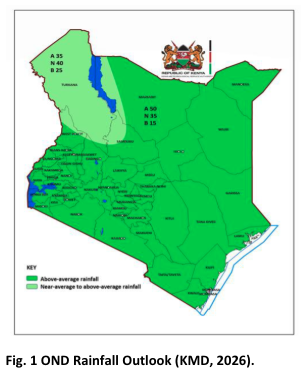
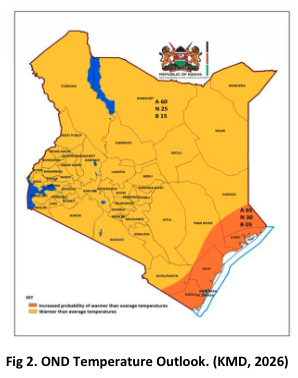
The significance of this forecast extends beyond the rainfall itself. Seasonal forecasts provide something critical for disaster risk management: lead time. Kenya has information about potentially hazardous conditions before the main rainfall season begins. This creates an opportunity to identify where risk may concentrate, prepare institutions and communities, pre-position resources, and activate anticipatory measures before a hazard becomes a humanitarian emergency.
But the forecast is not a disaster. El Niño does not mean that every part of Kenya will experience flooding, nor does the strength of the El Niño signal alone determine the severity of local impacts. What matters is how the climate signal interacts with rainfall intensity and distribution, river and drainage conditions, land use, infrastructure, exposure, and existing vulnerability. KMD therefore recommends using the seasonal outlook alongside shorter-term weekly and monthly forecasts and other monitoring products. (KMD, 2026).
This distinction is important because 20 millimeters of rain does not have the same meaning everywhere. The same rainfall can be relatively manageable in one location and disruptive or dangerous in another, depending on where it falls, how quickly it falls, what has already happened in the catchment and who or what is exposed.
This is why the critical question for OND 2026 is not simply how much rain is expected, but: Where could rainfall create significant impacts, who is most at risk, and what can be done before those impacts occur?
Kenya is not starting from zero
Kenya has made significant progress in building systems intended to disaster management from response towards anticipation. The national anticipatory action program currently reports coverage across all the 47 counties with more than 15 active early action protocols linking forecasts to pre agreed financing. The system brings together government, humanitarian, technical and county actors through a nation technical working group (TWG) (Government of Kenya, 2026)
The country has also strengthened the policy and financing foundations for anticipatory action. The Kenya Anticipatory Action Roadmap 2024–2029, identifies early warning and early action, coordination, financing and other elements as part of an end-to-end anticipatory system. The National Disaster Risk Management Act, 2026 provides a new framework for disaster risk management and coordination, while the Disaster Risk Financing Strategy 2026–2030 seeks to move Kenya from reactive disaster financing towards proactive and risk-informed financial preparedness. These developments matter because early action requires more than information. It requires decisions, authority, and resources.
Preparedness efforts are already underway for the coming season. The government has called on all 47 counties to map flood-prone areas, identify evacuation grounds, and strengthen measures to protect lives, livelihoods and critical infrastructure. The health sector has also activated preparedness measures and issued guidance to counties in anticipation of the October rains. (KNA, 2006). These developments matter. They demonstrate that Kenya has many of the building blocks required to act before disaster strikes. The challenge is whether these building blocks are sufficiently connected.
The missing link from forecast to action
The real test of preparedness is not simply whether a forecast is issued or whether an early warning system exists. It is whether information moves through the entire decision chain:
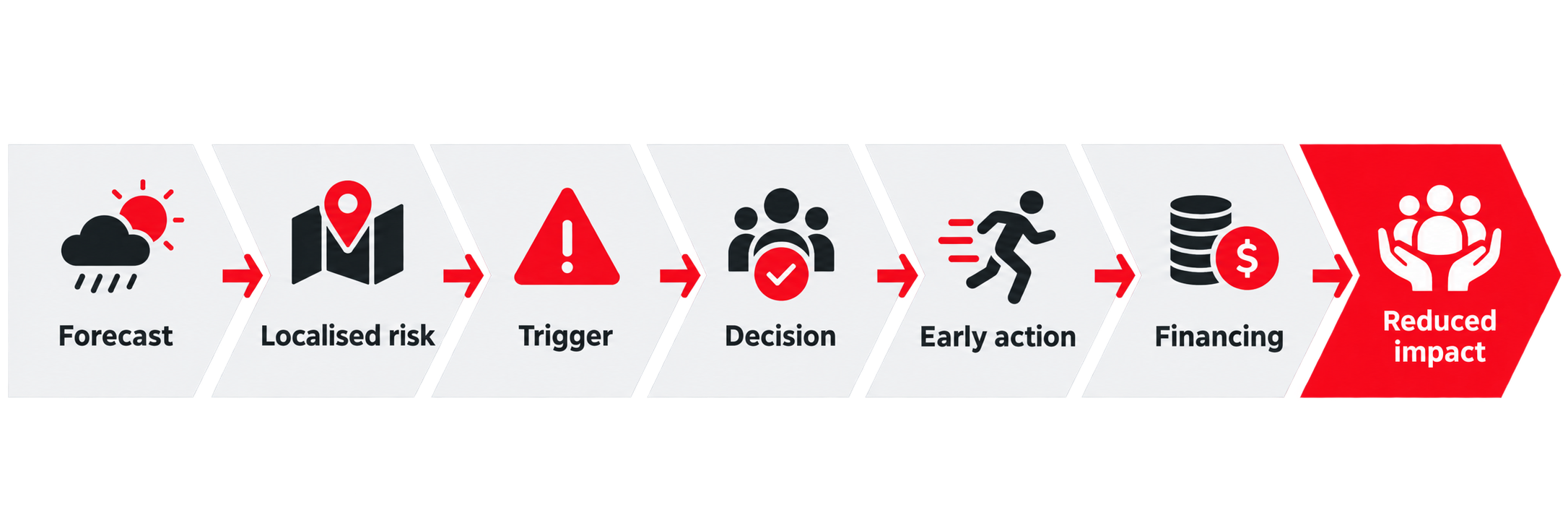
A seasonal forecast may identify an increased likelihood of above-normal rainfall, but decisionmakers need to know what that means for a particular county, settlement, river basin, livelihood system or critical facility. That localized risk information must then be connected to agreed thresholds that answer a practical question: when the forecast or observed conditions reach a certain level, what exactly should happen?
The next question is whether the resources are already available. An anticipatory action that depends on lengthy procurement, emergency fundraising or multiple layers of approval after a trigger has been reached is unlikely to make full use of the available lead time.
The final link is the community. A warning that does not reach people in a form they understand, through channels they trust, and early enough for them to act may not reduce risk. Recent government efforts to strengthen crisis communication and address last-mile communication gaps ahead of the 2026 rains recognize this challenge.
OND 2026 as a test of preparedness
The coming season provides an important opportunity to test how well Kenya’s preparedness systems work together. The country has stronger climate information capabilities, growing experience with anticipatory action, emerging county-level preparedness mechanisms, new disaster risk management legislation, and an evolving disaster risk financing architecture.
The challenge is to connect these elements into a system that can move quickly when risk increases. As OND approaches, preparedness should therefore focus on practical questions:
- Which areas face the greatest combination of hazard, exposure and vulnerability?
- What impacts are most likely?
- What conditions should trigger early action?
- Who has the authority to act?
- Are actions already agreed and operational?
- Are resources available before the hazard occurs?
- Can financing reach those responsible quickly enough?
- Can warnings reach communities in forms they understand and act upon?
The Window of Opportunity
The coming weeks are therefore particularly important. Kenya does not need perfect certainty about exactly where every flood will occur before taking action. Some measures are relatively low regret: clearing drainage systems, monitoring rivers and reservoirs, checking evacuation routes and shelters, protecting critical infrastructure, strengthening disease surveillance, pre-positioning essential supplies and ensuring that communities in exposed locations receive actionable information.
Other measures require more targeted risk analysis. These include activating anticipatory cash or livelihood support, preparing evacuation arrangements, protecting specific infrastructure, adjusting water and health services, and strengthening preparedness in locations where rainfall and exposure combine to create higher potential impacts.
The objective should be to use the seasonal forecast as the starting point for progressively more specific decisions as shorter-range forecasts and observations become available. This is particularly important because Kenya enters OND 2026 with existing vulnerabilities. The widespread flooding experienced during the March–May 2026 season demonstrated that exposure remains significant in many parts of the country. (OCHA, 2026). The experience should not be treated as evidence of El Niño impacts, but it does provide a reminder that communities and systems may already be operating with limited buffers before the OND season begins.
Kenya cannot control whether El Niño develops, where rainfall falls or when individual extreme events occur. But it can influence how prepared institutions and communities are before those hazards materialize. OND 2026 should therefore be more than a test of Kenya’s ability to forecast rainfall. It should be a test of the country’s ability to translate climate information into timely, coordinated and financed action.
The question is no longer simply whether Kenya has an early warning system. The real question is whether the warning can move fast enough—from forecast, to decision, to financing, to action. That is the real measure of preparedness.
References
- Kenya News Agency. (KNA) (2026). State steps up preparedness as El Niño rains loom -10 September 2026. https://www.kenyanews.go.ke/state-steps-up-preparedness-as-el-nino-rains-loom/
- Government of Kenya. (2026). disaster risk financing strategy 2026–2030. https://www.treasury.go.ke/sites/default/files/Latest%20updates/Kenya%20Disaster%20Risk%20Financing%20Strategy%202026%20-2030.pdf
- Government of Kenya. (2026). Kenya Anticipatory Action Programme. https://anticipatoryaction.ndoc.go.ke/aa
- Kenya News Agency (KNA). (2026). Ministry of Health activates El Niño preparedness ahead of October rains. Kenya News Agency, 15 September 2026. https://www.kenyanews.go.ke/ministry-of-health-activates-el-nino-preparedness-ahead-of-october-rains/
- IGAD Climate Prediction and Applications Centre (ICPAC). (2026). Summary for Decision Makers – October to December 2026 Season. 10 September 2026. https://www.icpac.net/publications/summary-for-decision-makers-october-to-december-2026-season/
- Kenya Meteorological Department (KMD). (2026). October–November–December (OND) 2026 Seasonal Weather Forecast. https://meteo.go.ke/our-products/seasonal-forecast/october-november-december-ond-2026-seasonal-weather-forecast/
- Kenya Meteorological Department (KMD). (2026).Kenya Anticipatory Action Roadmap – 2024 to 2029. https://meteo.go.ke/publications/kenya-anticipatory-action-roadmap-2024-to-2029/
- Kenya Law. (2026). National Disaster Risk Management Act -2026 https://kenyalaw.org/akn/ke/act/2026/16/eng@2026-06-02
- OCHA. (2026). Kenya: Humanitarian Snapshot (As of May 2026)
- https://www.unocha.org/publications/report/kenya/kenya-humanitarian-snapshot-may-2026
- Kenya News Agency (KNA). Government strengthens crisis communication ahead of anticipated El Niño rains. Kenya News Agency, 2 September 2026. https://www.kenyanews.go.ke/government-strengthens-crisis-communication-ahead-of-anticipated-el-nino-rains/
Discussion
Leave a comment