

At the beginning of March 2026, the excessive rains caused disastrous flash floods throughout Nairobi causing deaths, submerging roads, displacing families, and exposing the fragile intersection between rapid urbanization and climate risk.
Within 24hours, the rainfall of over 500mm (Dagoretti Met 112 mm, Wilson 160mm, Moi Airbase 145mm, Kabete 117mm), was registered, literally supplying over a month of rain in a single day. This is important since, as the statistics presented by the Kenya Meteorological Department (KMD) indicate, the average rainfall in Nairobi in the entire month of March is about 92.2 mm.
Practically, the city received more than 576% of its average monthly rainfall within a single day. This overworked drainage systems and caused high impact, rapid flooding.
A Forecasted Risk That Became a Crisis
In the days leading up to the event, KMD had issued heavy rainfall advisories indicating that moderate to heavy rainfall, ranging between 40 mm and 100 mm within 24 hours, would affect large parts of the country during the first week of March. Such rainfall thresholds are widely associated with high flood risk in urban environments.
However, localized rainfall in Nairobi exceeded projections in several areas, with weather stations such as Dagoretti and Moi Airbase recording significantly elevated totals. The gap was not in forecasting alone but in translating early warning into early action.
Where the Impact Was Felt Most
Neighborhoods including Kilimani, Westlands, and sections of the Nairobi central business district experienced severe surface flooding due to overwhelmed drainage systems and blocked waterways.
However, the most devastating impacts were concentrated in informal settlements located along the Nairobi River and its tributaries, including Kibera (particularly along the Ngong River), Mathare (directly along the Nairobi River), Mukuru kwa Njenga and Mukuru kwa Reuben, Korogocho and Informal sections of Kawangware.
These communities sit within natural floodpaths which are areas historically meant to absorb excess rain water. As a result, even moderate increases in water levels can quickly escalate into life-threatening flooding.
Why the City Could Not Cope
The Nairobi floods illustrate a convergence of structural vulnerabilities that extend beyond weather.
- Drainage Systems Designed for a Different Climate Reality
Urban drainage infrastructure in Nairobi was not built to handle rainfall events exceeding 100 mm within 24 hours. Once rainfall intensity crosses critical thresholds, runoff accumulates rapidly, overwhelming both formal drainage and natural waterways.
- Encroachment on Riparian Land
Decades of urban expansion have led to widespread settlement along riverbanks and flood paths. In many cases, these areas lack both formal drainage and flood protection measures.
- Solid Waste and Blocked Waterways
Blocked drainage channels, often clogged by uncollected waste, significantly reduce water flow capacity, accelerating surface flooding even in areas with existing infrastructure
- Climate Change and Rainfall Extremes
Rainfall patterns across East Africa are becoming increasingly erratic. Climate change is driving shorter, more intense rainfall events, where large volumes of rain fall within compressed time frames significantly increasing flood risk in dense urban environments
The Humanitarian Implications
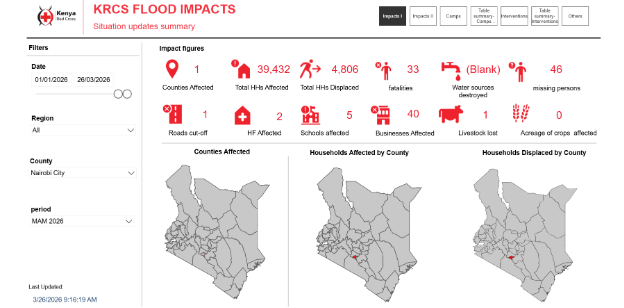
KRCS Floods Impacts Dashboard (Jan to March 2026)
Urban flooding of this scale is not just an infrastructure issue. It is a humanitarian crisis.
In high-density settlements, floods trigger cascading risks such as:
- Rapid displacement of households
- Loss of livelihoods and informal businesses
- Contamination of water sources and increased disease risk
- Disruption of transport, healthcare access, and supply chains.
For humanitarian responders, urban disasters create a triple operational constraint: impacts escalate within hours, affect dense populations simultaneously, and severely restrict physical access due to flooded infrastructure, congestion, and unplanned settlements.
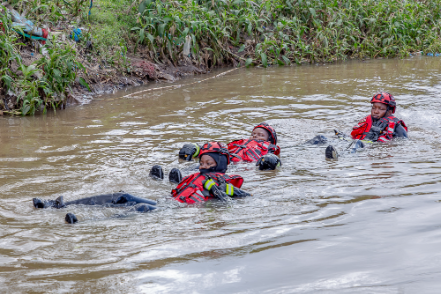
By nature, swift water rescue is a high-risk and technically complex undertaking, and this complexity is further compounded in urban environments such as Nairobi where unplanned settlements, poor drainage systems, and limited access routes significantly slow emergency response. The Nairobi County Government currently faces capacity constraints in executing specialized water rescue operations, particularly in swift water scenarios that require advanced technical skills, specialized equipment, and coordinated multi-agency response mechanisms. Swift water rescue demands rigorous training in hydrology dynamics, rope systems, boat handling, victim stabilization, and responder safety, skills that remain limited within the national emergency response ecosystem.
While Kenya Red Cross has trained responders and lifeguards who play a critical role in water safety and basic rescue operations, evidence and sector feedback suggest that most responders operate at foundational or intermediate training levels, with limited access to advanced swift water rescue certification and continuous professional development. This creates operational gaps during flood emergencies and riverine incidents, where highly specialized swift water rescue teams are required to operate safely and effectively in fast-moving and debris-filled waters.
To address this gap, there is a clear need for stronger collaboration across government agencies, humanitarian organizations, private sector actors, and training institutions to prioritize investment in advanced swift water rescue capacity. A coordinated sector-wide approach through joint training programs, shared equipment pools, and standardized rescue protocols would significantly strengthen preparedness and response in urban areas like Nairobi and other flood-prone regions.
Additionally, integrating modern water search and detection technologies such as Aqua Eye for rapid underwater screening and victim detection can greatly enhance rescue efficiency by reducing search time and improving responder safety. Prioritizing investments in advanced training, technology, and inter-agency coordination will strengthen emergency response capacity and position the humanitarian and disaster management sector to respond faster, safer, and more effectively to the increasing threat of flood-related emergencies.
From Early Warning to Early Action: The Critical Gap
The Nairobi floods highlight a persistent systemic failure: the disconnect between early warning and early action.
Forecasts were issued. Rainfall was anticipated. Yet preparedness measures particularly at the community and county levels remained insufficient.
Bridging this gap requires:
- Pre-positioning of emergency rescue assets
- Community-level alert systems and evacuation plans
- Clear evacuation protocols in high-risk zones
- Integration of meteorological data into early warning and local decision-making systems
Without these, early warning remains informational rather than operational.
What This Means for Humanitarian Innovation
For the International Center for Humanitarian Affairs (ICHA), the Nairobi floods are not just a case study. They are a signal. A signal that traditional response models are no longer sufficient in climate-exposed urban environments and we propose:
- Anticipatory Humanitarian Systems
The future lies in shifting from reactive response to anticipatory action. Using predictive analytics, climate data, and risk modeling to act before disasters occur.
- Data-Driven Urban Risk Intelligence
Geospatial mapping, flood modeling, and real-time rainfall monitoring must become standard tools for both city authorities and humanitarian actors.
- Climate-Resilient Urban Design
Humanitarian innovation must intersect with urban planning in ensuring that infrastructure, housing policy, and land use align with climate realities.
- Emergency Operation Centre
Improved and advanced monitoring systems with automated triggers that work independent of human interface.
- Community-Centered Preparedness
Communities in flood-prone areas must be equipped with first responders. This should be done through training, equipping, early warning access, and localized response systems.
A Defining Moment for Urban Resilience
The Nairobi floods demonstrate a new climate reality: extreme events are no longer rare, they are becoming the norm. When a single day’s rainfall can exceed an entire season’s average, the implications for cities are profound.
For policymakers, humanitarian actors, and innovators, the path forward is clear:
- Invest in resilience before disaster strikes
- Integrate climate data into decision-making
- Design systems that anticipate, not just respond
- Institutionalize and professionalize Search and Rescue Units
Because when the waters rise again, resilience will not be determined by how fast we react but by how well we prepared and responded to natures call.
Policy and Practice Recommendations
- Formalize and fund community-led disaster preparedness structures.
- Operationalize Early Warning Systems (EWS) by linking KMD forecasts to mandatory county level preparedness action
- Enforce routine clearing of drainage systems especially before rainy season
- Invest in decentralized waste systems in informal settlements.
- Enforce Riparian land regulations coupled with rights-based resettlement frameworks to avoid forced evictions.
- Develop and institutionalize real time flood risk maps integrating geospatial and meteorological data.
- Establish county level Anticipatory Action Financing
- Redesign Nairobi’s drainage systems to reflect future rainfall projections
- Align land use, housing, and climate adaptation policies
Sources
Reuters – Flash floods in Nairobi disrupt flights: https://www.reuters.com/sustainability/climate-energy/flash-floods-nairobi-kill-10-disrupt-flights-major-airport-2026-03-07/
AP News – Flash floods in Nairobi: https://apnews.com/article/d110ed756054d1ca6869aa3254b20d1f
Kenya Meteorological Department – Heavy rainfall advisory: https://meteo.go.ke/weather-warnings/updated-heavy-rainfall-advisory/
The Star Kenya – Kenya Met rainfall warning: https://www.the-star.co.ke/news/2026-03-03-kenya-met-warns-of-heavy-rainfall-this-week
IFRC – World Disasters Report 2023: https://www.ifrc.org/world-disasters-report-2023
UN-Habitat – World Cities Report: https://unhabitat.org/wcr
IPCC – Climate Change 2021: https://www.ipcc.ch/report/ar6/wg1/
World Bank – Kenya Climate Risk Profile: https://climateknowledgeportal.worldbank.org/country/kenya